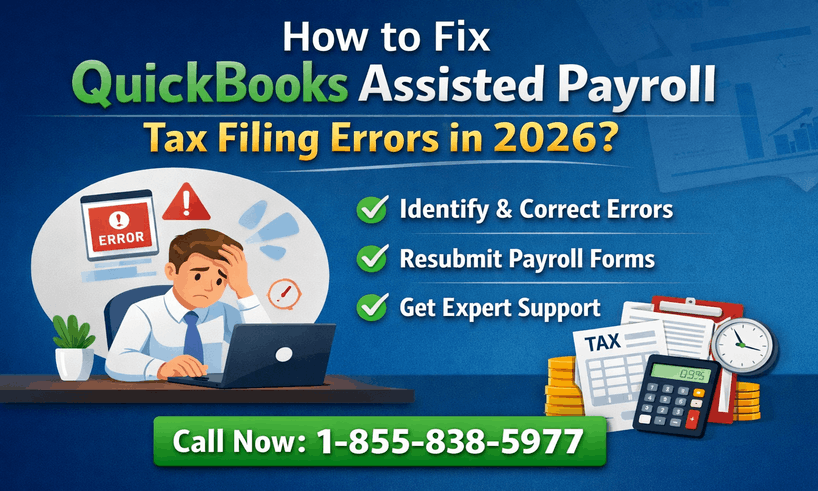
In 2026, QuickBooks Assisted Payroll continues to be a critical payroll solution for businesses that rely on accurate, compliant, and timely tax filings. Despite its advanced automation and compliance updates, payroll tax filing errors remain a common challenge due to configuration issues, data mismatches, regulatory changes, and integration failures. We address these challenges directly with precise, actionable solutions designed to eliminate errors and restore payroll accuracy.
This guide delivers a comprehensive, step-by-step framework to identify, resolve, and prevent QuickBooks Assisted Payroll tax filing errors, ensuring seamless operations and regulatory compliance throughout 2026.
Common QuickBooks Assisted Payroll Tax Filing Errors
- Incorrect Tax Calculations: Errors often arise from outdated tax tables, incorrect employee classifications, or mismatched state and local tax rates. These inaccuracies directly impact withholding amounts and reported liabilities.
- Rejected Tax Filings: Rejections typically occur due to invalid Employer Identification Numbers (EIN), incorrect agency account numbers, or discrepancies between payroll data and tax forms.
- Late or Missing Payments: Payment failures may result from bank authorization issues, insufficient funds, or delayed payroll submissions.
- Form Generation Errors: Issues with Forms 941, 940, W-2, or state-specific filings frequently stem from incomplete payroll data or misconfigured payroll items.
Preliminary System Checks Before Fixing QuickBooks Assisted Payroll Tax Filing Errors
- Verify QuickBooks Version and Payroll Subscription: We ensure that QuickBooks Desktop or Online is fully updated and that the Assisted Payroll subscription is active and properly licensed for 2026.
- Confirm Payroll Service Key Activation: A valid payroll service key guarantees uninterrupted access to tax table updates and filing services.
- Check Company File Integrity: We run built-in verification tools to confirm that the company file is free of data corruption that could affect payroll calculations.
Fixing Payroll Tax Calculation Errors
- Update Payroll Tax Tables: We navigate to the payroll settings and apply the latest 2026 tax table updates, ensuring compliance with current federal, state, and local regulations.
- Review Employee Tax Setup: Each employee profile must reflect accurate filing status, allowances, and residency details. We cross-check W-4 and state equivalents for consistency.
- Validate Payroll Items: Incorrect payroll items often lead to miscalculations. We confirm that wages, deductions, benefits, and employer contributions are properly mapped to the correct tax categories.
Resolving Rejected Payroll Tax Filings
- Correct Employer Identification Details: We verify EINs, legal business names, and registered addresses to match IRS and state agency records exactly.
- Fix Agency Account Numbers: State and local agencies require precise account numbers. We update these details within the payroll tax setup to prevent rejection.
- Resubmit Corrected Filings: After corrections, we regenerate the affected forms and resubmit them through the Assisted Payroll system with confirmation tracking enabled.
Addressing Late or Failed Tax Payments
- Review Bank Authorization Settings: We confirm that Electronic Funds Transfer (EFT) authorization is active and linked to the correct business bank account.
- Ensure Sufficient Funds: We schedule payments strategically to maintain adequate balances on withdrawal dates.
- Reprocess Failed Payments: QuickBooks allows reprocessing of failed payments. We follow the reinitiation process and monitor confirmation notices from tax agencies.
Fixing Payroll Tax Form Errors
- Rebuild Payroll Data: When forms generate incorrect totals, we rebuild payroll data to realign calculations with historical records.
- Amend Incorrect Filings: For previously filed forms with errors, we prepare and submit amended returns such as Form 941-X to correct discrepancies.
- Verify Year-to-Date Totals: Accurate YTD totals are essential for correct form generation. We reconcile payroll reports against tax liability summaries.
Handling Multi-State and Local Tax Errors
- Confirm State Tax Registrations: We ensure that all applicable state and local tax agencies are properly registered within QuickBooks.
- Assign Correct Work Locations: Employee work locations determine tax jurisdiction. We verify assignments to prevent incorrect state or local tax filings.
- Apply Reciprocal Tax Agreements: For states with reciprocity agreements, we configure exemptions accurately to avoid over-withholding.
Preventing Future QuickBooks Assisted Payroll Tax Filing Errors
- Implement Regular Payroll Audits: Scheduled payroll audits identify inconsistencies before filings are submitted.
- Enable Automatic Updates: We keep automatic updates enabled for tax tables, QuickBooks software, and payroll compliance changes.
- Maintain Accurate Employee Records: Ongoing updates to employee status, compensation, and tax information prevent downstream errors.
- Document Payroll Processes: Clear internal documentation ensures consistency and reduces the risk of manual entry errors.
Advanced Troubleshooting for Persistent Errors
- Use QuickBooks Diagnostic Tools: Built-in diagnostic utilities help detect and resolve hidden payroll configuration issues.
- Recreate Payroll Liability Accounts: In rare cases, recreating payroll liability accounts resolves persistent balance mismatches.
- Consult Payroll Compliance Reports: Detailed compliance reports provide insight into discrepancies between calculated and reported liabilities.
Best Practices for Assisted Payroll Compliance in 2026
- Stay Informed on Regulatory Changes: We monitor federal, state, and local payroll tax updates to maintain continuous compliance.
- Schedule Payroll Ahead of Deadlines: Early processing allows time to identify and fix errors before submission deadlines.
- Archive Payroll Records Securely: Secure record retention supports audits and simplifies future corrections.
Conclusion
By applying these precise, structured solutions, businesses can confidently fix and prevent QuickBooks Assisted Payroll tax filing errors in 2026. Accurate setup, proactive audits, and disciplined payroll management ensure timely filings, correct payments, and full regulatory compliance. With these practices in place, payroll operations remain efficient, compliant, and error-free throughout the year.
Still facing issues with QuickBooks Assisted Payroll tax filing errors in 2026? Don’t risk penalties or delayed filings. Get expert guidance to identify the root cause and fix payroll tax issues accurately. Call QuickBooks Payroll Support at 1-855-838-5977 for step-by-step assistance and reliable solutions.
Frequently Asked Questions
QuickBooks may miscalculate payroll taxes if the payroll tax tables aren’t updated, employee tax details are incorrect, or payroll settings aren’t configured properly. Outdated tax tables are one of the most common causes of tax miscalculations, as QuickBooks relies on current federal, state, and local tax rates to compute withholdings correctly. Incorrect employee tax setup (e.g., exemptions, filing status) can also prevent proper tax computation.
To fix incorrect W-2/W-3 forms:
1. If discovered before filing, correct the employee or payroll data in QuickBooks and file normally.
2. If already filed, contact support (for services where QuickBooks files forms for you). QuickBooks will prepare and file corrected W-2c and W-3c forms with the Social Security Administration and provide copies to you.
QuickBooks Assisted Payroll might not work if the payroll subscription is inactive, not updated, or incorrectly set up, or if there are data issues in the company file. Problems accessing payroll features can also be tied to permission settings or incomplete setup of payroll tax payments and filings. Additionally, errors can appear if the system cannot update its payroll components or tax tables.
The “Access is Denied” error usually signals a permissions or connection issue in QuickBooks — for example, if the system cannot authenticate your access to certain data or payroll forms. This can happen when browser cookies/cache interfere with QuickBooks Online pages or when firewall/security settings block access to payroll resources. Clearing browser cache or cookies often resolves this error.
This error often appears when QuickBooks tries to update payroll, open payroll forms, or access state/federal files but cannot due to permission restrictions or file access issues. Running QuickBooks as Administrator and adjusting Windows folder permissions for the QuickBooks program files typically resolves it.
If tax forms (like 940, 941, W-2, W-3) aren’t showing up as filed, it may be because the payroll tax update is outdated or the forms haven’t yet been properly saved or saved under the correct payroll center. Updating payroll tax tables and ensuring you’ve filed the forms correctly will help them appear in the “Filed” section.
To set up local taxes in QuickBooks Online Payroll:
1. Go to Payroll Settings and select local taxes under the state tax area.
2. Enter your local tax account number and deposit frequency.
3. Assign the correct local tax jurisdictions to each employee based on their home/work addresses.
4. Save the settings and confirm that the local taxes appear on paychecks.
QuickBooks may stop calculating employee payroll taxes when:
1. The payroll subscription has expired or is inactive.
2. Payroll tax tables are outdated and need updating.
3. Employee tax setups aren’t configured correctly (e.g., incorrect exemptions or missing information).
4. There’s a system glitch or company file issue affecting payroll calculations.